How to Choose Preschool Sensory Furniture?
Choosing Preschool Sensory Furniture begins with watching how children actually use a classroom. One child may settle on a soft floor cushion, while another prefers pushing a sturdy seat with both feet grounded. These small observations matter more than choosing products because they look calming in a catalog. Good furniture can offer different ways to sit, move, pause, and explore without turning the room into a collection of distractions.
Look closely at materials, stability, cleanability, and age-appropriate sizing. A textured panel should feel interesting, not scratchy; a wobble stool should remain steady under ordinary use. Check seams, edges, weight limits, and the space needed around each item. Ask educators and caregivers what they notice during transitions, quiet play, and group activities. Then introduce a few pieces and observe what changes. Keep what supports participation; reconsider what is ignored or causes crowding. There is no single setup that works for every child, and even a sensible choice may need adjusting. That part is easy to overlook. Sensory preferences can differ, shift, and sometimes surprise us. A thoughtful selection process treats furniture as one practical classroom support, not a guaranteed solution, and gives children room to show what feels useful.
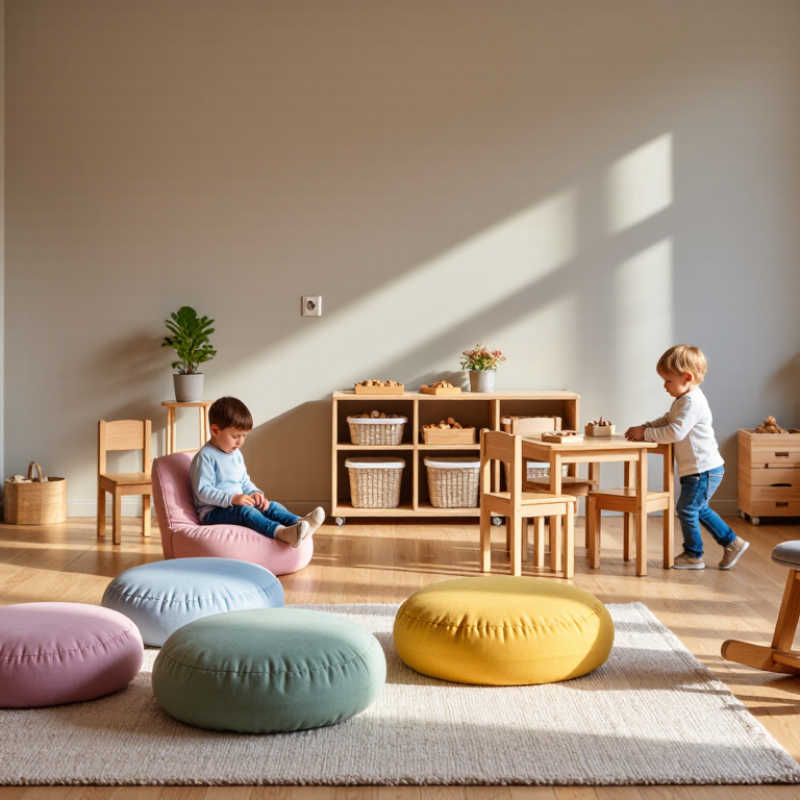
Define Sensory Needs for Ages 3–5 Before Selecting Furniture
How to Choose Preschool Sensory Furniture?
Define Sensory Needs for Ages 3–5 Before Selecting Furniture
Children ages 3–5 can respond very differently to sound, touch, movement, and busy rooms. One child may seek a soft seat; another may prefer a firm chair and clear space. Watch children during ordinary moments, such as story time, transitions, and free play. Note what they choose, avoid, or return to over several days. Look for patterns, not labels. A rocking seat may help one child settle and distract another. A checklist can guide observations, but it can also make a lively child seem like a problem. Keep the child’s own choices in view.
Use those observations to guide furniture choices. If children often leave their feet dangling, try chairs that let them sit with feet supported. If a quiet corner attracts children, arrange a small, open area with a soft rug and comfortable seating. Choose sturdy, easy-to-clean surfaces for frequent use, and leave clear paths between activity zones. Offer a few distinct options rather than filling the room with competing textures and shapes. Then watch how the furniture works in practice. A cushion that feels inviting on Monday may be ignored by Friday. Adjust slowly, ask educators and families what they notice, and remember that no single setup suits every child.
Match Seat and Table Heights to EN 1729-1’s Eight Size Marks
How to Choose Preschool Sensory Furniture?
Match Seat and Table Heights to EN 1729-1’s Eight Size Marks
A child should sit with feet supported, knees comfortably bent, and shoulders relaxed at the table. CEN’s EN 1729-1:2015 defines eight size marks for educational chairs and tables, using specified seat and table heights. The paired dimensions are: mark 0, 210/400 mm; 1, 260/460 mm; 2, 310/530 mm; 3, 350/590 mm; 4, 380/640 mm; 5, 430/710 mm; 6, 460/760 mm; and 7, 510/820 mm. The first figure is seat height; the second is table height.
For preschool rooms, marks 0–2 are useful starting points, not age-based rules. Measure a seated child’s lower leg from the floor to the underside of the knee, then check that the table allows relaxed arm movement. A sensory activity may involve leaning, sorting, or pressing materials, so stable footing matters. Small details count.
Choose furniture with the same size mark for the chair and table. Avoid pairing a low chair with a high tabletop; children may lift their shoulders or lean forward to reach. Yet a standard chart cannot account for every child, shoe, cushion, or classroom task. Recheck fit as children grow, and observe them during real activities. A tape measure helps. Observation matters too.
How to Choose Preschool Sensory Furniture? - Match Seat and Table Heights to EN 1729-1’s Eight Size Marks
| EN 1729-1 Size Mark | Nominal Seat Height | Nominal Table Height | Sensory Furniture Selection Check |
| 0 | 210 mm | 400 mm | Check that the child can sit with feet supported and reach the tabletop without raising the shoulders. |
| 1 | 260 mm | 460 mm | Choose a stable seat; if sensory movement is part of the activity, keep the work surface steady and clear. |
| 2 | 310 mm | 530 mm | Confirm that the child can sit upright and place forearms comfortably on the table during hands-on activities. |
| 3 | 350 mm | 590 mm | For tactile play, leave enough tabletop space for materials while keeping frequently used items within easy reach. |
| 4 | 380 mm | 640 mm | Check the seated posture with the actual activity materials; avoid a table height that makes the child hunch or shrug. |
| 5 | 430 mm | 710 mm | Match the seat and table as a pair, and make sure any movable seat remains stable during the intended activity. |
| 6 | 460 mm | 760 mm | Check that feet are supported and that the child can work at the tabletop without leaning forward excessively. |
| 7 | 510 mm | 820 mm | Use the same posture check: stable sitting, supported feet, relaxed shoulders, and comfortable reach across the work surface. |
How to use this guide: The heights shown are nominal dimensions associated with the EN 1729-1 size marks; seat height is measured from the floor to the top of the seat, and table height from the floor to the tabletop. The sensory-furniture checks are practical selection tips, not additional EN 1729-1 requirements. Confirm fit with the child and the furniture manufacturer’s specifications before purchase.
Check Chair Strength and Stability Using ISO 7173 and ISO 7174
How to Choose Preschool Sensory Furniture?
A chair used for sensory activities should stay steady when a child leans, shifts, or climbs on and off. ISO 7173 provides methods for assessing chair strength and durability under specified test conditions. ISO 7174 addresses chair stability. These standards offer useful evidence, but they do not guarantee that every chair suits every preschool setting. Check that the report names the exact model and configuration you plan to buy. A different seat height or base can change performance.
Tips: Request the test report, not just a claim of compliance. Confirm the testing laboratory, standard edition, and results. Ask whether the chair was tested with any accessories you intend to use. Then inspect samples for loose joints, sharp edges, and rocking on a level floor.
Test results matter. So does daily use. Consider the child’s size, movement, and activity, and follow the maker’s setup and weight guidance. Watch how the chair behaves during ordinary supervised use. A report cannot show every classroom condition, and I might be overcautious here; still, that gap deserves attention. Choose furniture that is easy to check and maintain, and review it regularly for wear.
Choose Commercial Seating for Normal or Severe Use Under EN 16139
How to Choose Preschool Sensory Furniture?
For commercial preschool seating, EN 16139 offers a useful way to compare strength, durability, and safety. It distinguishes between two use levels: Level 1 for general use and Level 2 for severe use. The right choice depends on how often and intensively children will use the furniture, not just how sturdy it looks. Busy rooms see chairs dragged, bumped, and climbed on. Small details matter.
Level 1 may suit seating in calmer areas with moderate daily use. For a high-traffic classroom, shared therapy room, or space where furniture is moved frequently, Level 2 may be more appropriate. Severe use does not mean indestructible. It indicates a higher test level, not a promise that furniture cannot wear or fail. Ask the supplier for documentation that identifies the tested model and its use level. A label alone is not enough.
EN 16139 applies to seating; it does not assess every sensory feature or prove that a chair suits every child. Check dimensions, stability, cleanable surfaces, and support needs alongside the test information. If possible, observe children using a sample: feet may dangle, or a seat may feel too restrictive. That small trial can reveal issues a specification sheet misses. It is easy to focus only on the standard. Comfort and fit still matter.
How to Choose Preschool Sensory Furniture? Choose Commercial Seating for Normal or Severe Use Under EN 16139
How to read this chart: EN 16139 distinguishes Level 1 (general use) and Level 2 (severe use). The chart shows 100,000 and 200,000 seat-and-back durability test cycles respectively. For preschool furniture, verify the intended user and applicable standard: EN 16139 is for adult non-domestic seating, while EN 17191 covers seating for children. Choose products according to age fit, supervision, cleaning needs, and expected intensity of use; check the relevant standard and test configuration for the specific product.


