China’s modular building sector has moved beyond temporary site cabins. Factories now produce steel frames, volumetric rooms, bathroom pods, and complete housing modules with impressive speed. Yet speed alone does not prove quality.
This guide examines China’s top 10 modular building manufacturers through practical criteria. These include factory capacity, engineering expertise, material traceability, customization, certifications, delivery experience, and after-sales support. Project records matter. So do independent inspections and clear technical documentation. A polished showroom can hide weak coordination. That deserves attention.
Mark Farmer, a respected construction economist and author of Modernise or Die, stated, “Modernise or Die.” His warning fits modular construction particularly well. Manufacturers must improve design coordination, digital production, quality control, and workforce skills. Otherwise, modular buildings may repeat conventional construction problems inside a faster factory process.
This ranking is not an absolute verdict. It is a research starting point for developers, contractors, architects, and international buyers. Some manufacturers excel in residential projects, while others focus on hospitals, schools, offices, or worker accommodation. The strongest supplier depends on location, building codes, climate, budget, and installation conditions.
Look closely. A low quoted price may exclude transport, foundation work, taxes, or commissioning. Factory photographs may also show older projects. Buyers should request recent references, inspection reports, structural calculations, and realistic production schedules. China offers substantial manufacturing depth, but careful verification remains essential. Even experienced purchasers can overlook small details that later become expensive.
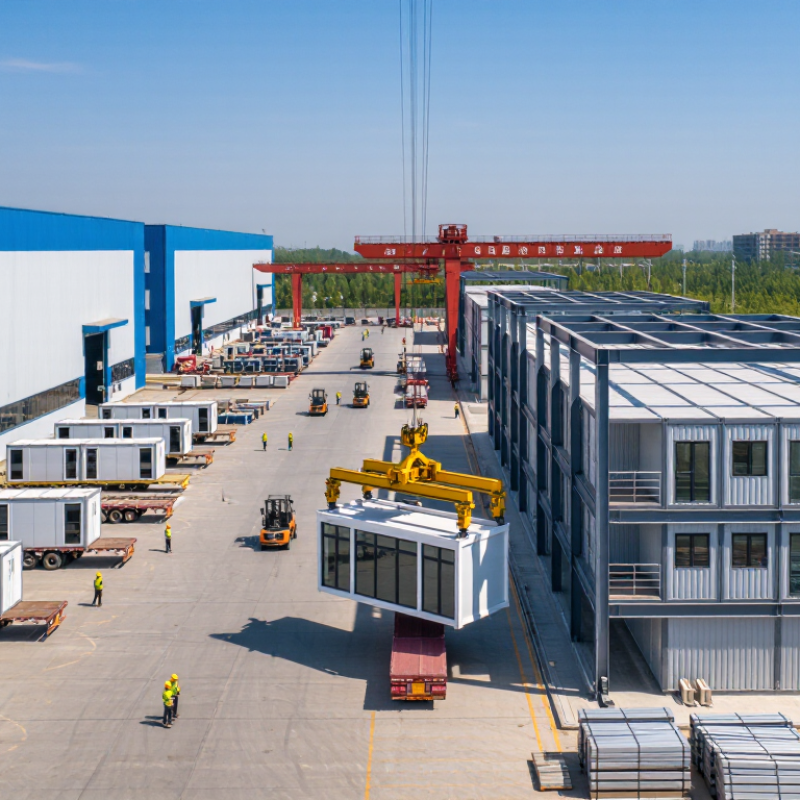
China’s modular building manufacturing industry has expanded from basic prefabricated rooms to engineered housing, offices, clinics, and accommodation units.
Factories commonly use light-gauge steel, welded frames, insulated panels, and factory-installed services. Controlled production can reduce weather delays and improve dimensional consistency. Yet quality still varies between suppliers. A polished showroom does not prove reliable performance.
Experienced buyers examine weld records, material certificates, fire ratings, insulation values, and water-sealing details. They should also review factory capacity, installation support, and previous projects with similar climates. A serious manufacturer explains tolerances, transport limits, maintenance needs, and approval requirements clearly.
Independent inspections remain useful, especially before shipment. Drawings may look complete, but small connection details can create expensive site problems.
Tips:
Request a sample wall section and inspect its joints, fasteners, and insulation layers. Compare quoted specifications with the actual bill of materials.
Ask how the factory handles design changes, damaged components, and replacement parts. Do not judge only by price.
A cheaper module may require stronger foundations, extra site labor, or earlier repairs.
In my experience, communication is often the weakest link, although buyers sometimes underestimate their own unclear requirements. Local climate data, wind exposure, and intended occupancy should shape every technical decision.
A top-ten list can attract attention, but it cannot replace careful evaluation. During factory visits, I learned that polished showrooms reveal little about production discipline. Buyers should inspect welding areas, insulation storage, connection details, and finished modules. Ask for project records, structural calculations, material certificates, and realistic delivery schedules. Reliable manufacturers explain limitations clearly. They do not promise everything.
Technical capability matters, but coordination matters more. Evaluate design support, BIM compatibility, factory quality control, packaging methods, and installation guidance. Check how the supplier manages design changes and site delays. Request references from projects with similar climates, building codes, and occupancy needs. Independent inspections can verify dimensions, fire performance, moisture protection, and electrical workmanship. Total cost should include transport, foundations, assembly, maintenance, and replacement parts. A low quotation may hide expensive adjustments.
Tips: Compare at least three suppliers using the same specification. Visit the factory, if possible. Review warranty terms line by line. Ask who owns the drawings. Confirm testing laboratories and certificate validity. My early mistake was trusting attractive renderings too quickly. Real performance depends on ordinary details, such as sealed joints and accurate floor levels. No supplier is perfect. The strongest partner documents problems, corrects them, and communicates before small defects become site failures.
China’s top ten modular building manufacturers should be judged by core capabilities, not output volume alone. Their strongest differences appear in design engineering, factory automation, BIM coordination, and quality control. The best producers can convert digital models into repeatable modules, with accurate joints, protected services, and documented inspection points. Factory discipline matters.
McKinsey’s report, Modular Construction: From Projects to Products, indicates that modular methods can reduce schedules by 20–50% and costs by up to 20%. These figures depend on early design decisions, stable procurement, and disciplined installation. Leading Chinese manufacturers therefore need proven structural systems, fire safety testing, moisture control, and reliable export logistics. Their ability to adapt modules for hotels, housing, healthcare, and remote projects also deserves careful comparison.
Low-carbon performance is another core capability. The 2024 Global Status Report for Buildings and Construction states that buildings consumed about 32% of global energy and produced approximately 34% of global carbon emissions in 2022. Manufacturers using recycled steel, efficient insulation, and factory waste tracking respond more credibly to this pressure. Yet rankings remain imperfect. Public data is uneven. Buyers should verify certificates, completed projects, defect records, and after-sales response before accepting any “top ten” list.
China Top 10 Modular Building Manufacturers?
China’s top ten modular building manufacturers should be judged by more than factory size. Buyers need evidence of product quality, delivery control, and site performance. Key products include volumetric rooms, light-gauge steel frames, precast concrete units, and bathroom pods. McKinsey reports that modular construction can reduce project schedules by up to 50% and lower costs by about 20%. That benchmark is useful, but not universal.
Technology separates capable suppliers from ordinary fabricators. Strong manufacturers use BIM coordination, automated cutting, robotic welding, digital quality records, and factory-based testing. These systems reduce clashes between plumbing, electrical lines, and structural parts. However, software alone proves little. A site inspection should examine tolerances, moisture control, fire-rated assemblies, and connection details. Small errors become expensive after modules leave the factory.
Construction applications are broad. Modular units support worker housing, hotels, schools, clinics, offices, and emergency accommodation. The 2023 Global Status Report for Buildings and Construction states that buildings consume 34% of global energy and produce 37% of energy-related emissions. Efficient envelopes, insulated panels, heat-pump systems, and low-waste production therefore matter. Delivery records matter too. Some suppliers advertise speed, yet ignore transport limits or local codes. That weakness deserves reflection. A practical comparison should include tested performance, installation training, maintenance access, and verified project references.
| Rank | Manufacturer Profile | Primary Product Category | Key Technologies | Typical Construction Applications | Main Structural Materials | Relevant Standards and Quality Practices |
|---|---|---|---|---|---|---|
| 1 | Profile A | Volumetric steel modules | Factory welding, precision assembly, integrated MEP installation, digital production control | Hotels, apartments, student housing, worker accommodation | Galvanized steel frames, sandwich panels, gypsum boards, mineral wool | Welding inspection, dimensional checks, fire-performance testing, ISO-style quality management |
| 2 | Profile B | Light-gauge steel modular buildings | Cold-formed steel roll forming, CNC cutting, bolt-and-screw connections, BIM-based detailing | Low-rise housing, schools, clinics, offices and site facilities | Cold-formed galvanized steel, cement boards, insulation panels, aluminum windows | Structural calculations, corrosion protection, wind-load and seismic-load design review |
| 3 | Profile C | Prefabricated container-type units | Modular steel chassis, rapid panel installation, plug-and-play electrical systems | Temporary offices, construction camps, emergency shelters, classrooms | Welded steel, EPS or rock-wool panels, plywood flooring, PVC or metal cladding | Factory acceptance checks, electrical safety testing, transport and lifting procedures |
| 4 | Profile D | Prefabricated concrete modules | Reinforced-concrete casting, reusable molds, embedded services, controlled curing | Permanent apartments, bathrooms, student residences, utility buildings | Reinforced concrete, rebar, insulation layers, factory-installed finishes | Concrete strength testing, reinforcement inspection, curing records, lifting-point verification |
| 5 | Profile E | Hybrid steel-concrete modular systems | Composite floor systems, bolted connections, prefabricated MEP racks, BIM coordination | Mid-rise residential buildings, hotels, hospitals, mixed-use developments | Structural steel, concrete slabs, light-gauge partitions, mineral wool insulation | Connection testing, fire-resistance design, acoustic detailing, construction tolerance control |
| 6 | Profile F | Expandable and relocatable modules | Folding frames, hydraulic or manual expansion mechanisms, compact transport design | Remote accommodation, disaster response, mining camps, temporary medical facilities | Galvanized steel, insulated panels, waterproof membranes, modular plumbing | Repeated assembly testing, transport stability checks, weatherproofing inspection |
| 7 | Profile G | Modular bathrooms and service pods | Wet-area prefabrication, waterproofing systems, preassembled plumbing and electrical services | Hotels, hospitals, apartments, student housing and public buildings | Steel or composite shells, cement boards, ceramic finishes, PEX or multilayer piping | Water-pressure testing, drainage testing, waterproofing inspection, electrical safety checks |
| 8 | Profile H | Prefab industrial and commercial buildings | Portal-frame fabrication, automated cutting, large-span structural design, insulated envelope systems | Warehouses, workshops, logistics centers, agricultural and commercial facilities | Hot-rolled steel, profiled metal sheets, insulated sandwich panels, concrete foundations | Steel traceability, coating-thickness checks, structural load calculations, site bolt inspection |
| 9 | Profile I | Sustainable timber and hybrid modules | Panelized timber construction, digital fabrication, low-waste cutting, high-performance insulation | Eco-homes, resorts, villas, community buildings and low-rise offices | Engineered timber, plywood or OSB, recycled insulation, steel connectors | Moisture control, fire detailing, timber grading, thermal and acoustic performance checks |
| 10 | Profile J | Integrated modular building systems | BIM-to-factory workflows, prefabricated façade systems, MEP integration, smart-building provisions | Large residential projects, healthcare facilities, education campuses and public infrastructure | Steel or concrete modules, curtain-wall components, prefabricated MEP assemblies | Design coordination, factory inspection plans, commissioning procedures, documentation for local code approval |
Note: The profiles are anonymized manufacturer categories. Actual product specifications, certifications, structural systems and construction approvals should be verified against each supplier’s current technical documentation and the applicable local building codes.
China Top 10 Modular Building Manufacturers?
When comparing Chinese modular building manufacturers, quality evidence matters more than factory photographs. ISO 9001 certification supports process control, but it does not guarantee every shipment. Buyers should request welding records, concrete test results, fire ratings, and independent inspection reports. Check sample walls, door seals, floor levels, and electrical labels before signing. Small defects become expensive after ocean delivery.
Export capability requires more than a low quoted price. The supplier should explain container loading, moisture protection, customs documents, installation drawings, and local code coordination. ISO 19650 principles can improve information management for complex projects. EN 1090 or equivalent steel fabrication evidence may also support structural confidence. However, standards differ by destination. A certificate alone is not enough.
Time savings still attract buyers. McKinsey’s 2019 modular construction report indicated that modular methods could reduce project schedules by 20–50% and costs by up to 20%. These figures are potential outcomes, not promises. The United Nations Environment Programme reported that buildings represented about 34% of global energy demand and 37% of energy-related emissions in 2022. Therefore, buyers should compare insulation values, thermal bridges, ventilation, and future energy use. A cheaper module may perform poorly in a cold climate. That lesson is easy to miss. Request a factory audit, verify references, and keep payment milestones linked to measurable inspections.
A company-neutral reference chart showing internationally recognized standards frequently reviewed during modular building procurement.
The chart uses the publication or amendment year of commonly referenced standards: ISO 9001 for quality management, ISO 14001 for environmental management, ISO 45001 for occupational health and safety, ISO 19650 for BIM information management, and EN 1090-1 for structural steel and aluminium conformity assessment. Buyers should verify the current edition, product scope, factory documentation, testing records, export packaging, installation support, and destination-country compliance before comparing suppliers.
| Cookie | Duration | Description |
|---|---|---|
| cookielawinfo-checkbox-analytics | 11 months | This cookie is set by GDPR Cookie Consent plugin. The cookie is used to store the user consent for the cookies in the category "Analytics". |
| cookielawinfo-checkbox-functional | 11 months | The cookie is set by GDPR cookie consent to record the user consent for the cookies in the category "Functional". |
| cookielawinfo-checkbox-necessary | 11 months | This cookie is set by GDPR Cookie Consent plugin. The cookies is used to store the user consent for the cookies in the category "Necessary". |
| cookielawinfo-checkbox-others | 11 months | This cookie is set by GDPR Cookie Consent plugin. The cookie is used to store the user consent for the cookies in the category "Other. |
| cookielawinfo-checkbox-performance | 11 months | This cookie is set by GDPR Cookie Consent plugin. The cookie is used to store the user consent for the cookies in the category "Performance". |
| viewed_cookie_policy | 11 months | The cookie is set by the GDPR Cookie Consent plugin and is used to store whether or not user has consented to the use of cookies. It does not store any personal data. |